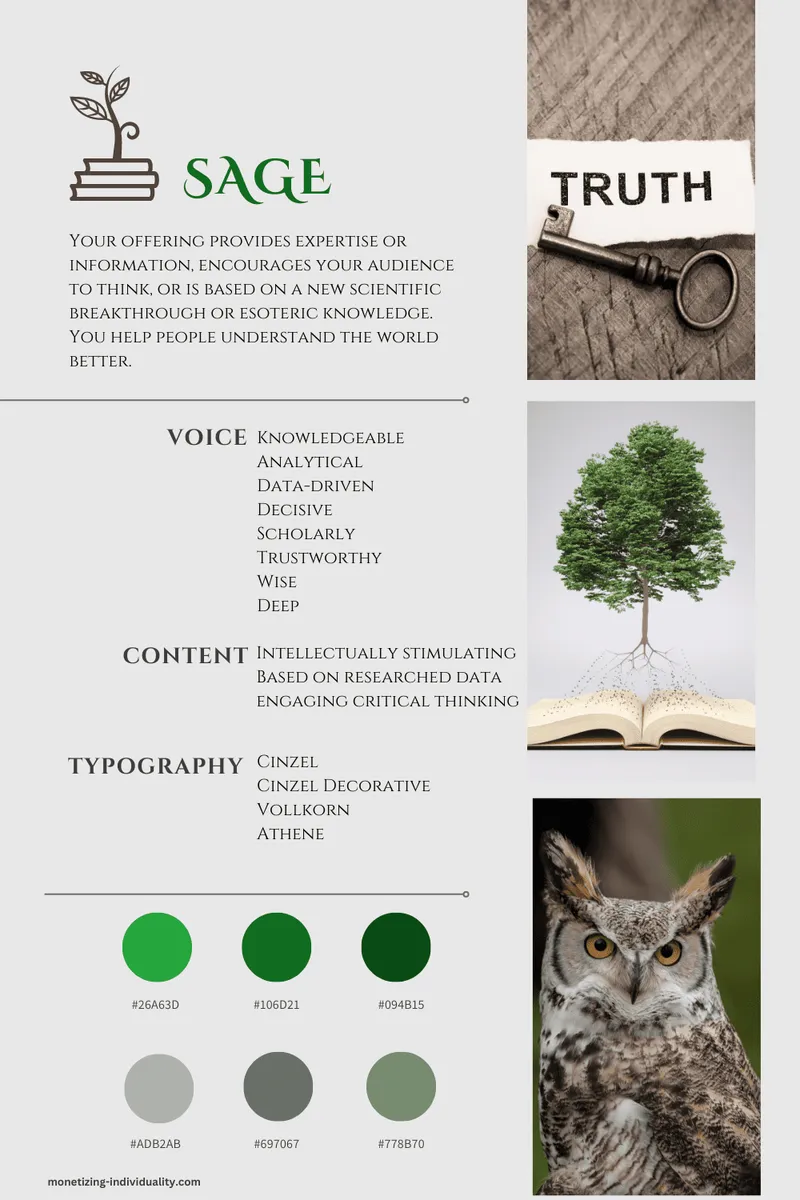
This profile explains why people bring you their hardest questions, trust your verdicts over their own instincts, and keep coming back for the next one.
You hold knowledge as a discipline, not a decoration. What looks like natural authority is actually a habit: test the claim, weigh the evidence, then share the conclusion plainly enough that the person asking can use it. Compassion tempers the rigor — you would rather correct someone gently than let them fail informed.
Your knowledge was built, not inherited — years of study, testing, and revision. You hold tradition and new evidence in the same hand, updating your position the moment better data arrives, because objectivity outranks being right the first time.
You see the connections others miss — the pattern linking a policy to its outcome, a product to its second-order effect. That systems view is the real value you sell: not information, but the map that makes the information make sense.
The Catalogue of Tells
Traits are opinions. Behavior is data. Tally how many of these already describe you.
Tap each tell that fits you.
0of 10 signs
Wrong shelf. Take the test and find where you're actually catalogued.
Your Essence
Core Desire
To uncover the truth of things and share it clearly enough that others can act on it.
Strengths
Insight · Systems Thinking · Lifelong Learning · Objectivity · Curiosity · Research · Rational Judgment
Information Overload · Dogmatism · Skepticism · The Humility-Authority Balance · Relevance · Monetization
“The first principle is that you must not fool yourself — and you are the easiest person to fool.”
Richard Feynman, Caltech commencement, 1974
Your Journey
I
Goal
Gather deep understanding and pass it on intact — advice people can act on, not just admire.
II
Strategy
Build a reputation on being right, checkable, and current: publish the reasoning, not just the conclusion.
III
Fears
Being wrong in public. Being ignored when you're right. Losing the objectivity that makes your word worth taking.
The Errata
Every discipline of knowledge casts two failure modes: one that stopped questioning, one that never stopped preparing to answer.
The Dogmatist
Certainty that outlived its evidence.
Early signs
Conviction
New evidence gets argued away instead of examined.
Rigidity
Disagreement reads as ignorance, not information.
Contempt
You haven't updated a position in years.
The correction
Schedule your own peer review. Invite someone whose job is to prove you wrong.
The Eternal Student
Research substituted for the verdict it was supposed to produce.
Early signs
Studying
You research one more source before every answer you already have.
Stalling
Your published work trails your actual knowledge by years.
Withholding
You qualify a confident conclusion into a shrug.
The correction
Publish the verdict you have today. A late truth helps no one.
Four Expressions of the Sage
Four disciplines of knowing. One of them is yours.
Detective
The Detective reads the scene before the story is told — the detail everyone else skipped is where the truth was hiding. Curiosity here is disciplined into method: gather the evidence, test each explanation against it, discard what doesn't survive scrutiny. The reward isn't the confession. It's the moment the pattern finally holds together, and every loose thread accounts for itself. In business: due diligence in person — the one who finds the number that changes the meeting.
Mentor
The Mentor teaches upward, never down — the assumption is always that you're capable of more, not less. Guidance here is customized: listen first, diagnose what's actually missing, then hand over exactly that. Satisfaction comes from watching a student outgrow the need for you. A Mentor's real measure isn't how much they know. It's how far the people around them go. In business: the adviser whose questions outlive the engagement — capability built, not dependence.
Shaman
The Shaman works where the data hasn't arrived yet — pattern recognition running ahead of proof, the trained hunch that knows which question to ask next. The method looks unlike a Detective's, but the standard is identical: the insight has to survive contact with reality. In business: the seasoned operator whose gut is a compressed archive — consulted before the numbers exist, checked against them after.
Translator
The Translator's material is meaning, not vocabulary — the same idea lands differently in every language, culture, and audience, and the gap between them is exactly the job. Precision matters here as much as it does for a Detective: choose the wrong word and the whole message misfires. What crosses the bridge intact is understanding itself — carried carefully enough that nothing essential is lost in the crossing. In business: the bridge between the experts and the buyers — makes the technical truth sellable without bending it.
The Symposium
No archetype operates alone. Your second archetype decides what kind of Sage you become — each pairing below is a different practice.
Scroll to choose
Sage+
=
The Institution
Knowledge with the authority to govern, not merely inform — the standard the field cites.
Price is a claim like any other — it needs evidence behind it. Five laws keep it defensible.
§ I
Price the Synthesis
The search is free online. What you sell is the hours spent turning scattered facts into one defensible answer.
§ II
The Verdict Is the Product
Clients don't buy your research. They buy the conclusion they can act on without re-checking your work.
§ III
Free Knowledge, Paid Decisions
Publish what you know at no charge — it earns trust. Charge for what you decide; that's what earns revenue.
§ IV
Cite Your Rate
State the fee plainly, with the reasoning behind it. A price that hedges reads like a conclusion that hedges.
§ V
Decline the Undergraduate Question
Free consultations answer what a search engine already answers. Reserve your hours for what only you can settle.
The Plates
How a Sage looks before it says a word. This page follows its own rules — the doctrine, applied.
The palette
Night Study
#0D1410 · the ground
Deep Green
#106D21 · the shelf
Spring Green
#26A63D · the lamp's glow
Patina
#A9BFA7 · the metal
The Dust
#333B36 · the shadow wash
Reading Plate
#EDEFE6 · the page
One dark ground, one live green, one patina metal. The dust stays in its shadow corner.
The letterforms
Aa
A decorative engraved display serif
Bookplate capitals — ornament earned by content, never worn below 20px.
Aa
A sturdy text serif
Built for long paragraphs — its name literally means 'wholegrain'.
What the plates keep
A double rule between claim and body
Symmetric, quiet composition
One green accent per plate, never wallpaper
Generous margins — a page meant to be read
What the plates reject
Diagonals, tilts, anything that performs
Gold or silver metal — the Sage's metal is patina
Dust outside a shadow context
Ornament without a job to do
The Citation Chain
The Sage is not a modern invention. It's one of the oldest roles in human history — and the chain currently ends with you.
c. 400
Hypatia
Taught mathematics and astronomy in Alexandria, and defended reason as a discipline, not a privilege.
1025
Ibn Sina
Completed the Canon of Medicine — a standard of evidence that governed practice for six centuries.
1903 · 1911
Marie Curie
Won Nobel Prizes in two different sciences — physics, then chemistry — on measurements she verified herself.
1980
Carl Sagan
Put the standard on television — extraordinary claims require extraordinary evidence — rigor, said gently, to millions.
Now
You
The chain holds as long as someone keeps citing sources instead of certainty.
Famous Sages
Alan Watts
Jane Goodall
Morgan Freeman
Grace Hopper
Sadhguru
Sylvia Earle
The Bibliography
Sage brands rarely announce their expertise. Each demonstrates one law of evidence, quietly and often unglamorously.
M
The Michelin Guide
House law · The Anonymous Inspector
Stars decided by inspectors who never announce themselves — judgment kept honest by anonymity for over a century.
B
Britannica
House law · The Verified Entry
Every entry passes an editor before it passes a reader.
M
McKinsey
House law · The Verdict as Product
Clients pay for the recommendation, not the research deck behind it.
N
Nature
House law · The Standard of Proof
Peer review before publication: the finding isn't real until it's checked.
W
Wolfram
House law · The Computed Answer
One query returns one verified answer, not a list of links to sort yourself.
The Three Editions
Sage authority isn't granted once. It's earned across three editions, and each one demands different work.
Act I — The student years
The First Edition
You read everything, defer to everyone with more evidence, and keep your conclusions provisional. The goal isn't to be right yet — it's to be rigorous enough that being right becomes possible.
The work:Read past the point of comfort.
Act II — The authority years
The Revised Edition
Your name now carries weight before you've finished the sentence. The discipline shifts: fewer opinions, offered more carefully, because a wrong verdict now costs someone else, not just you.
The work:Say 'I don't know' before you say something unverified.
Act III — The teacher's years
The Definitive Edition
The measure stops being what you know and becomes what you've handed off. A Sage's final act is training the judgment that will outlast their own.
The work:Build a student who eventually corrects you.
The Defense
Three archetypes get mistaken for the Sage daily. Each pair resolves under one question.