As a Caregiver, you are built for the moment someone else runs out of strength. Comfort, a steady hand, a sympathetic ear — you supply what distress takes away, and you do it without keeping score. People remember you less for what you said than for what you carried.
Your sense of duty runs deep — one meal, one favor, one late-night call at a time. At work it is the same instinct in a different uniform: the team that doesn't burn out because you watch the load, the client who stays ten years because someone finally listened. You find your own footing in the footing you give others.
The world you're building is one where care moves both ways: safety offered freely, confidence returned in kind. You measure your work in small, specific changes — the person who finally slept, the one who didn't have to ask twice — because that's where empathy actually lands.
The Night-Nurse Round
Adjectives are easy to claim. These aren't adjectives — they're things that actually happen. Count how many are true of you.
Tap each sign that's true of you.
0of 10 signs
This isn't your instinct — and that's not a flaw. Take the test and find the archetype that actually is.
Your Essence
Core Desire
To protect and nurture the people who need it — building real safety, comfort, and connection, not just the feeling of being looked after.
“Look for the helpers. You will always find people who are helping.”
Fred Rogers, passing on his mother's counsel
Your Journey
I
Goal
To aid and protect the people around you — building safety, healing, and wellbeing through acts of compassion that ask for nothing back.
II
Strategy
You offer reliable, hands-on support — comfort, aid, a sense of belonging — until the people who lean on you trust you'll still be there tomorrow.
III
Fears
Being mistaken for selfish or uncaring. And the harm that finds someone you couldn't reach in time to help.
The Empty Pitcher
Every act of care casts two shadows. One holds on until it controls. One gives until there's nothing left to give.
The Smotherer
Care that stopped asking permission.
Early warnings
Helping
You help before anyone asks, then wait to be thanked.
Controlling
You make other people's decisions 'to save time.'
Smothering
Someone else's independence feels like a small rejection.
The remedy
Ask before you act. Then let the answer — even a 'no' — actually stand.
The Martyr
The self, poured out past the last boundary.
Early warnings
Giving
You say yes before you've checked what it costs you.
Depleting
Your own needs sit on a list that never gets reached.
Disappearing
You feel guilty resting while anyone nearby is still struggling.
The remedy
Learn the difference between pouring and draining — then stop before the pitcher rings hollow.
Four Expressions of the Caregiver
Four ways care shows up. One of them is how you arrive.
Angel
A guide as much as a helper — offering comfort, direction, and unmistakable warmth. The Angel radiates a joy that isn't performed, and helps people find their footing again: a clearer sense of who they are, and how they belong to the people around them. In business: the mentor people leave lighter — the door that is somehow always open at the right hour.
Guardian
Identity built on defending what matters — people, values, the things worth keeping. The Guardian carries traditions forward, reads a room's real risks, and quietly manages what needs managing: privacy respected, accountability kept, harm kept out. Self-sacrifice, here, is just part of the job. In business: the keeper of the culture — protects the standards, the institutional memory, and the people who would otherwise be spent like budget.
Healer
Not the one who heals — the one who builds the conditions healing needs. The Healer reads pain accurately, stays sensitive to what isn't said, and keeps sight of what's already whole in a person, even when they can't see it themselves. Restoration, not repair. In business: the leader who builds the conditions good work needs — safety to speak, sane workloads, teams that recover instead of churn.
Samaritan
Lives by one rule: help the person in front of you, whether or not they asked. The Samaritan notices need before it's spoken, shows up for strangers the same way they'd show up for family, and measures the day by whose suffering got smaller. In business: the first responder of the org chart — covers the gap, takes the shift, asks questions later.
The Care Circle
No one is only one archetype. Your second shapes what kind of Caregiver you become — eleven pairings, eleven different ways of showing up.
Scroll to choose
Caregiver+
=
The Protector
Care backed by real authority — protection with the power to actually make it stick.
Price is where care either survives or quietly bleeds out. Five laws keep the giving sustainable enough to keep giving.
§ I
State the Boundary
A price is a boundary said out loud. Without one, care has no edge — and no edge means nothing left to give.
§ II
Burnout Serves No One
Free help that costs you everything helps no one twice. Charge enough to still be here for the second ask.
§ III
Price to Stay Standing
Underpricing isn't generosity — it's a countdown. Charge enough that you're still doing this work next year.
§ IV
Say the Number Plainly
Apologizing for your fee teaches people to expect the apology, not the service.
§ V
Keep a Reserve
Don't fill every hour with routine work. Leave room for the call that can't wait.
The Linen Drawer
How a Caregiver brand looks before it says a word. This page follows its own rules — warmth as structure, never decoration.
The palette
The Hearth
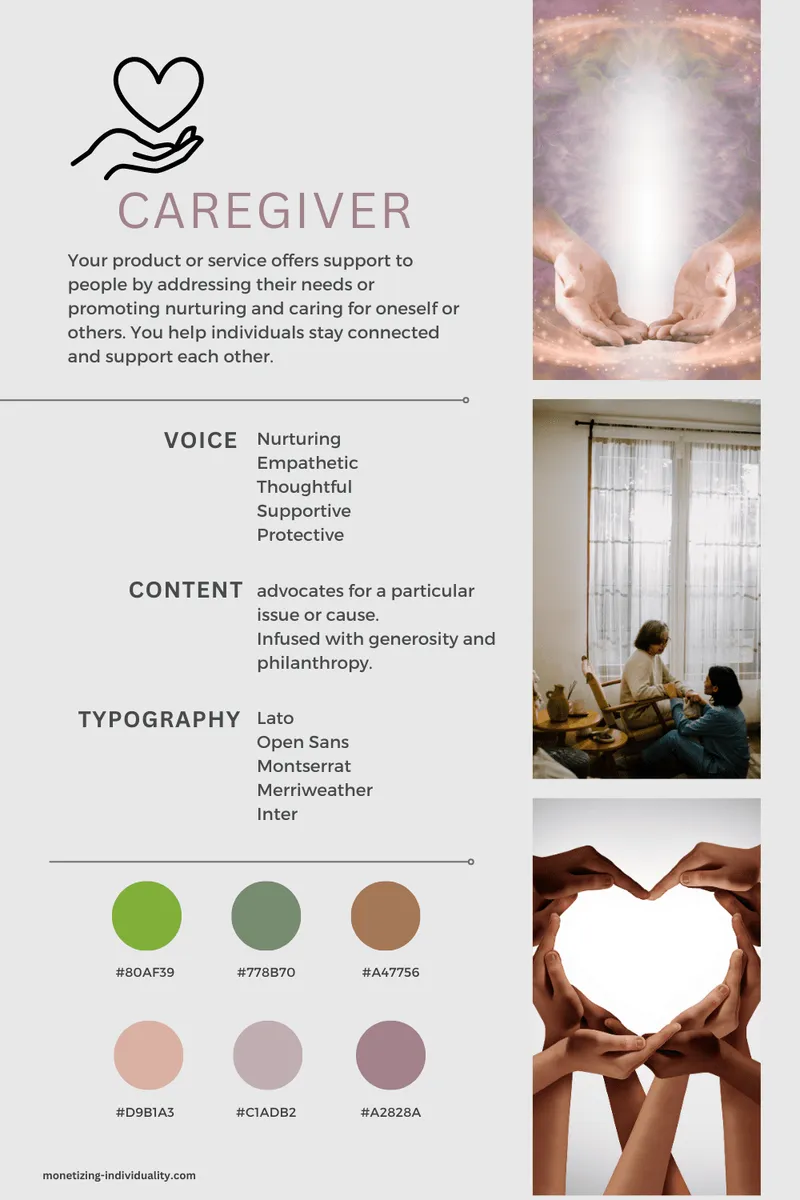
#211317 · the ground
Blush Linen
#F6EDE7 · the plate
Hearth Copper
#C29A77 · the glow
Spring Green
#80AF39 · the tended life
Sage Green
#778B70 · the quiet second
Firelight Paper
#F4E9E9 · the page's own light
One warm ground, one metal, one living green. Never a hospital's cold light.
The letterforms
Aa
A warm-bodied serif
Bedtime-story cadence with a spine — for the words that hold.
Aa
A plain, kind sans
Labels and controls that never upstage the person being helped.
What the hearth wears
Warm dark grounds, lit from one source
Soft-squared corners, never sharp points
One green thing, alive and tended
Stitched borders that visibly hold pieces together
What it never wears
Hospital-corridor lighting or clinical white
Charity-ad sadness or pity imagery
More than one metal tone
Plum outside a shadow context
The Lamplighters
Long before anyone sold anything, someone sat with the sick and stayed. The line of those who stayed runs, for now, to you.
1854
Florence Nightingale
Took a lamp into the Crimean War wards and turned nursing into a discipline, not an accident.
1863
Henry Dunant
Turned the horror of Solferino into the Red Cross — care organized at the scale of a war.
1955
Jonas Salk
Refused to patent the polio vaccine — could you patent the sun? — care priced at zero, on purpose.
1967
Cicely Saunders
Founded the modern hospice — decided that how people are accompanied at the end is medicine too.
Now
You
The pattern continues through anyone who keeps showing up. That's the entire inheritance.
Famous Caregivers
Angelina Jolie
Mahatma Gandhi
Malala Yousafzai
Mother Teresa
Princess Diana
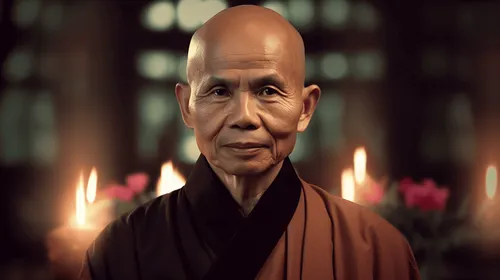
Thích Nhất Hạnh
The Households
Caregiver brands rarely announce themselves. Each of these demonstrates one law of care, without ever having to say the word.
J
Johnson & Johnson
House law · The credo first
A 1943 credo ranks patients and doctors above shareholders, in writing, since before it was required.
P
Pampers
House law · The parent's sleep
Sells dry nights, not diapers — the product is measured in hours of rest returned to exhausted parents.
V
Volvo
House law · The family's shell
Built its entire reputation on the promise that everyone inside the car comes home.
A
Allstate
House law · The good hands
Four words held since 1950 — "You're in good hands" — insurance sold not as a payout but as the person who shows up.
N
Nivea
House law · The blue tin
A century-old jar passed between generations — care sold as constancy: same tin, same promise, every winter.
The Three Seasons of Care
The Caregiver isn't a role you take once. It's three seasons of work, and each one asks something different of you.
Act I — Early practice
The Tending
Care that's mostly hands-on: showing up, doing the thing, being physically present for whoever needs it. You learn what people actually need by paying close attention, not by asking.
The work:Earn the first 'I don't know what I'd have done without you.'
Act II — Established
The Holding
The circle depending on you widens past what your hands alone can cover. You build routines, systems, other hands — the work becomes holding space, not just filling it.
The work:Build something that holds people when you're not in the room.
Act III — Mature
The Teaching
The final measure of a Caregiver is who else learned to tend. Pass the instinct on, deliberately, so the care doesn't end where your reach does.
The work:Teach someone else to carry what you've been carrying.
The Family Meeting
Three archetypes get mistaken for the Caregiver constantly. One question separates each pair.